
Getting Hockley County Court Records
Start with the case type. The District Clerk keeps the felony criminal, district civil, and family files of the 286th District Court. Misdemeanor and civil matters in constitutional County Court, along with probate, sit with the County Clerk, while every JP and municipal court holds its own lower-court files. A request aimed at the wrong office only slows the docket search down.
- Locate the court and case number through the relevant docket, notice, or Hockley County case lookup.
- Describe the document, such as a petition, motion, order, judgment, docket sheet, or probate filing, and give a date range.
- State whether a plain informational copy or a certified copy is needed.
- Contact the proper clerk to confirm availability, fee, identification rule, delivery method, and current turnaround.
- Submit through an accepted route: counter, mail, phone coordination, District Clerk fax if accepted, or the office's linked online system.
- For records outside the case file, ask whether Texas Rule of Judicial Administration 12 applies rather than assuming a generic public-information form controls.
Registered users can pull filings through re:SearchTX. It helps, but it cannot certify a copy, and it does not promise that every Hockley County record made it online.
Two Hockley Clerk Counters
Hockley County runs a split clerk model. Both principal clerks work inside the courthouse, so the office title on a request matters as much as the street address.
District Clerk Oralie Gutierrez
802 Houston Street, Suite 316
Levelland, TX 79336
806-894-8527
Fax: 806-894-3891
District felony, civil, and family files.
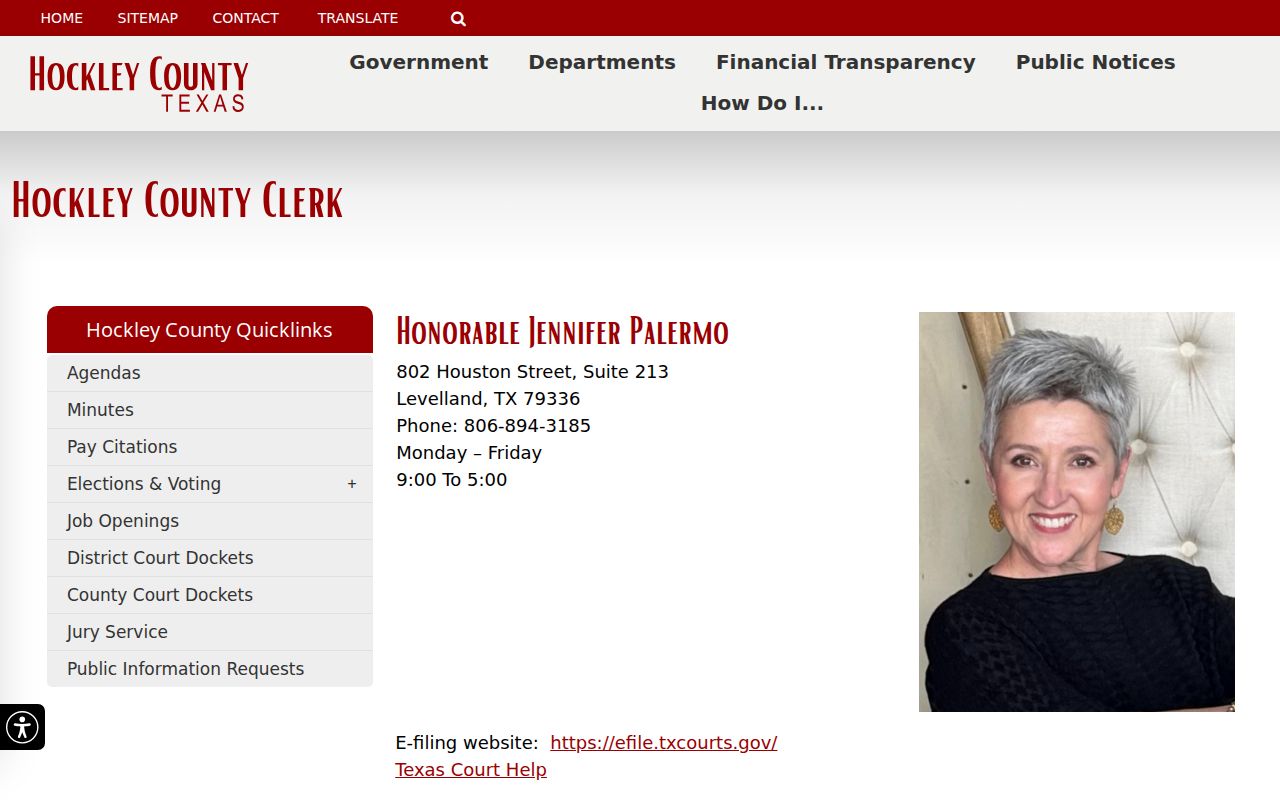
County Clerk Jennifer Palermo
802 Houston Street, Suite 213
Levelland, TX 79336
806-894-3185
Monday through Friday, 9:00 a.m. to 5:00 p.m.
County, probate, and clerk records.
The District Clerk page shows its current record and service links.
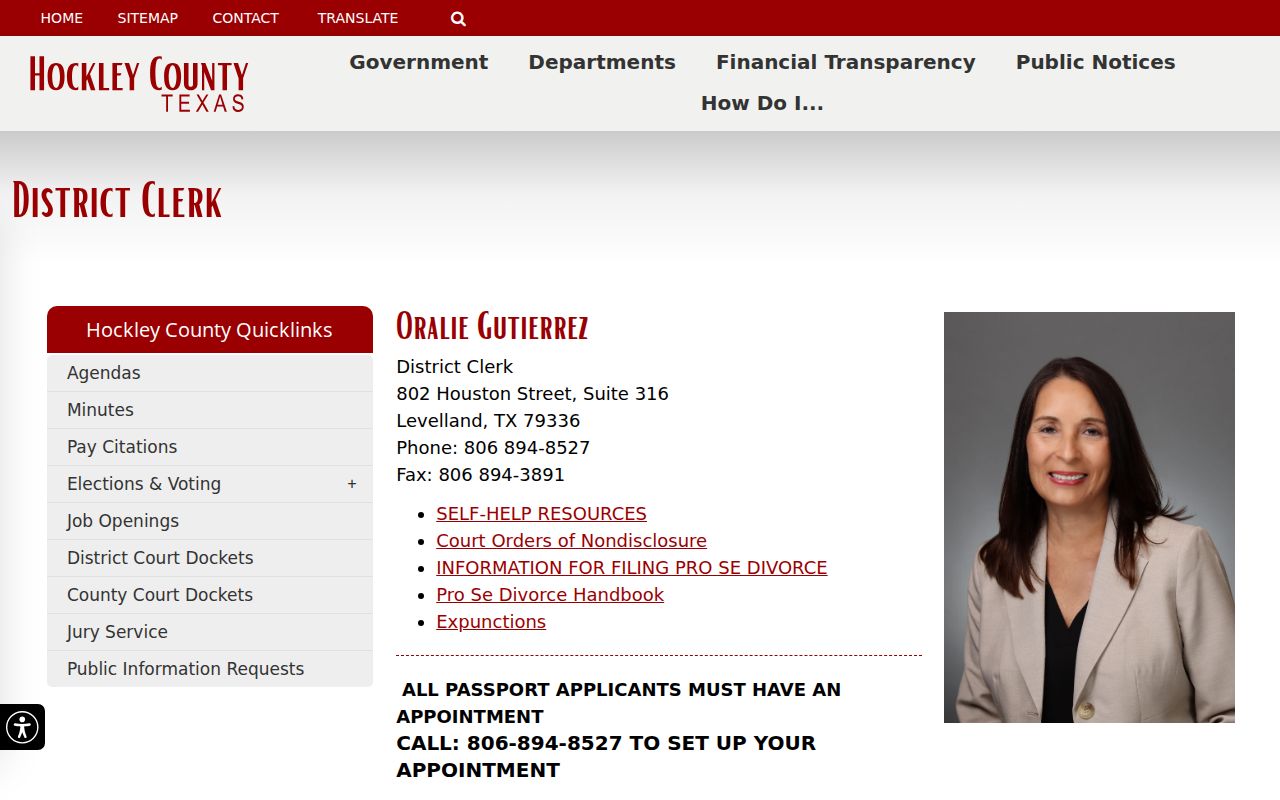
Check the office page for current routing before calling. Its links cover expunction, nondisclosure, divorce, and other topics, though they do not open every related file to the public.
Court Record Types
Each product answers a different need. Asking for “the record” can be too broad, since one Hockley County file may hold many entries.
- Docket sheet: the chronological list of events, settings, and filings.
- Filed document: a petition, complaint, motion, response, exhibit, or other item accepted in the case.
- Court order: a signed ruling or directive from the judge.
- Judgment: the court's formal disposition of claims or charges when entered.
- Certified copy: a clerk-certified reproduction for a use that requires official authentication.
- Transcript: a record of spoken proceedings, requested through the court reporter rather than treated as an ordinary clerk copy.
A docket entry noting that an order was filed is not the order itself. Ask for the paper by its title and date whenever possible.
Three Hockley Record Products
Separate search information, file content, and authentication. That split avoids an incomplete request faster than anything else.
| Product | What it provides | Where to ask |
|---|---|---|
| Docket | Dates, actions, filing labels, and settings | Online archive, portal, or clerk |
| Filed document | The text or image behind an entry | Custodian of the case file |
| Certified copy | A copy carrying clerk certification | County or District Clerk, or lower-court clerk |
| Transcript | Recorded words from a proceeding | Court reporter |
Casual research may need nothing more than a plain copy. A filing for another proceeding or some other formal use may require certification, and the receiving body should state its requirement.
Inside Hockley County Court Records
What is inside varies by court and case. Still, a few fields help pinpoint the right file.
| Court and case number | The owning court and unique local identifier. |
|---|---|
| Case style or parties | The names used on the file, subject to access limits. |
| Case type and charge | The civil category, probate matter, offense, or lower-court subject. |
| Docket entries | Dated filings, settings, actions, orders, and disposition entries. |
| Filed images | Documents available for inspection or copy under applicable rules. |
| Certification | The clerk's official attestation when purchased and available. |
The county's published criminal sample lists case number, time, party, prosecutor, court action, offense, attorney or bondsman, defendant, and bond. Read it as the docket's anatomy. It is not the full text of each paper underneath.
Hockley County PDF Archive
The county's free County Court Dockets page reaches back to at least 2017. Links are grouped by date and type. It works well for locating a public criminal setting. It also teaches the wording Hockley County uses on local dockets. Some older PDFs are scans, though. Text search can miss them, and the archive index shows the publication pattern.
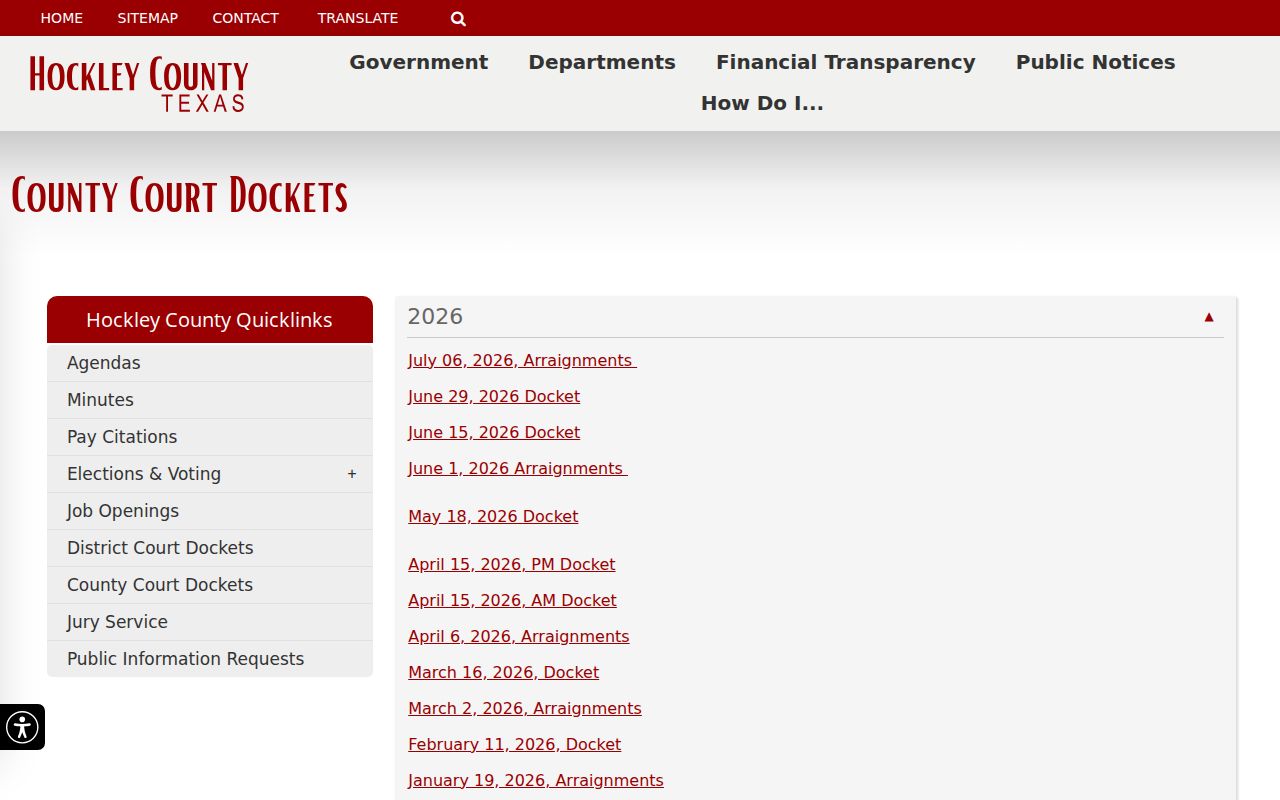
The archive route is not a complete online court file. Once a relevant row turns up, the County Clerk or the court itself can address the underlying document.
Fees and Certified Copies
Official Hockley pages link to fee schedules. The county posts no single current price covering every plain page, docket sheet, certified document, exemplified copy, search, or online image. Confirm the amount before mailing payment or placing a large order.
| Request | Published exact amount | Next step |
|---|---|---|
| Plain copy | Not located | Ask the correct clerk for per-page and delivery fees |
| Certified copy | Not located | Confirm certification plus page charge |
| Exemplified copy | Not located | Ask whether the custodian offers it |
| Older-file search | Not located | Ask about retrieval time and cost |
| Transcript | Not located | Request a quote from the reporter |
Never borrow a recording-office envelope rule or a statutory expunction fee for an ordinary court-copy request. Each charge has its own purpose.
Older Hockley File Requests
An older Hockley County file may sit in a legacy index, a bound volume, on microfilm, or in an archived image system. Texas Government Code preservation provisions let district-clerk records be kept through image and microfilm methods, yet the county publishes no complete digitization inventory. So give the clerk as much as you can. Name the court and the exact paper sought. Add the full case number if known, the party style, case type, and date range. Say whether you need a plain or certified copy. Add how it should be returned and where the office can reach you. Confirm payment and any identity requirement before sending funds or personal data. That one phone call can save a round trip.
Older record missing online? A failed portal or PDF search is not proof the file was destroyed or never existed.
Ask the custodian to check legacy indexes and storage formats for the stated court and years.
Hockley Records Through Time
Ground broke on the current courthouse on August 20, 1927. The building opened in 1928. Levelland's official history names Preston Lee Walker as architect. It describes a three-story Renaissance Revival and classical structure. Today, clerk counters in that landmark share space with NetData, eFileTexas, re:SearchTX, scanned PDFs, and posted online dockets. The County Clerk page shows its current office and service links.
That mix of paper and pixels is why no single portal covers every year and file type. A Hockley County search may start online and still finish at the correct counter.
Sealed Records and Public Access
Public access does not open every page of every case. Texas Rule of Civil Procedure 76a governs sealing in civil court records. Criminal expunction law can remove qualifying records from public reach. The Family Code shields whole categories of information. Juvenile, child-protection, and family matters fall there. Privacy and redaction rules still apply. They can strip sensitive data from a copy that is otherwise public. The Texas judicial open-records policy draws a line. Courts and Judicial Branch agencies are not handled under the Texas Public Information Act in the ordinary agency-records way. Rule 12 addresses access to judicial records. It is not a generic search form for the contents of any court case. Requests still go to the correct clerk or court custodian.
Access can be partial. A public docket may remain visible when an underlying paper is sealed, restricted, or released only in redacted form.
The county courthouse overview shows the local government entry point.

The county page routes residents to departments and record sources. For the access rule on one particular case file, the office itself still governs.